Sunday, January 15, 2012

Neritidae

Group of Clithon corona

These beautiful snails hail from the Neritidae family.  They are close relatives to the common Olive Nerites, Zebra nerites, red spotted and so on.  These horned nerites, however, are my favorite of them all.  Their yellow and black stripes appeal to me and who wouldn't love those horns?  A horned snail is definitely a unique spectacle to most.  

Aside from being aesthetically pleasing however, their function is much greater.  They are #1 on cleaning glass algae.  
All the snails available in the freshwater hobby under the name "Nerite" are excellent glass algae scrapers.  If you ever get tired of green spot algae, brown spot algae or anything that requires you to scrape, these snails will do the job for you.  
I have kept these before a few years ago, when I was in the hobby.  I had a 10 gallon tank with all four walls covered in thick brown glass algae.  I threw in a few (2-3) olive nerites and within a week, it was clean and clear.  I never had to stick my hand in there to scrub the glass.  

Clithon corona will do the same and also give your tank a nice looking specimen.  I would recommend at least 1 per 10 gallons.  I added 4 in my 20 gallon tank because I will be moving 2 into the CBS tank in the near future, when it is done cycling.  

To record this process, I have taken photos of my tank currently.  


As you can see, the walls are quite filthy.  My previous blog posts of shrimp even show the brown spot algae on my photos.  It clouds my images immensely.  

Today is day #1 of adding the snails (January 15, 2012).

When taking nerites into consideration as a co-inhabitant in your shrimp tank, you should understand that these guys will NOT breed in freshwater.  So if your tanks are snail free like mine and you want to keep it that way, these guys are perfect for you.  (Although technically nerites are snails...)
Furthermore, nerites, like all snails, ideally require higher ph water to maintain good shell growth.  Because we keep CRS in lower ph, do expect shell degradation overtime.  Shell thinning and possibly getting "uglier" over a period of time will be normal and should be expected.  It's an unfortunate fate for these guys.  
Average lifespan seems to be approximately 1.5-2+ years.  This has been reported by local aquarists that I have spoken to and my own personal experience as well.

FAQ
Q:  Can nerites breed in freshwater?
A:  No, but they do lay eggs that will never hatch.  Eggs can be spotted as white dots in your tank.  They are often laid on driftwood or any hard surfaces.  Some argue that in exchange for no algae, you end up with eggs all over the place.  I never had this problem though as the eggs usually disappear overtime.  They will only lay an abundance of eggs if your tank is literally infested with too much algae.  


I will update how the tank is doing in the next couple days.


More photos to below.  

More Berries!

Alas, the breeding has come and it continues.  Yesterday, there was another molt and a berried female.  This morning, I found three more berried females!  What a wonderful surprise, after a terrible time at the bar last night.  Haha!

It's funny how my heart is filled with bliss just by watching my shrimp.  Most people would just look at me crazy...

FAQ:
Q:  When will other females get berried once I get my first?
A:  When you get your first berried female, expect other sexually mature females to follow her lead within the next following days! 

Here's one hanging on the sponge filter.

 Two of the five going for my Mosura Specialty Food bait!

 Pregnant female

Pooping pregnant female

Friday, January 13, 2012

First berried CRS

I received my CRS approx. 1 month ago on Dec. 11, 2011.  After doing a top-off last night, one of my females molted.  A few hours later, I watched multiple males (about 3, my M-F ratio is skewed.  More females than males) harassing her.  I knew this was a sign:  I'm going to have my first berried (pregnant) female soon!

This morning, when I went to check on my tank.  Lo and behold, my first berried female.

Now, this post is to record the time it takes for a newly introduced CRS to start getting berried.  My friend told me it took about a month, I said 3 weeks or so.  I was wrong.  Caridina sp. such as Crystals took me about a month indeed.  I believe 3 weeks is for Neocaridina sp.  But... that needs to be officially tested still.

FAQ:  
Q:  How soon should I expect my CRS to start carrying eggs?
A:  Approx. 1 month


*****
Please note that the time/duration will vary accordingly to the conditions you keep them in.  I've kept my tanks pretty stable with no giant swing in parameters.  Stable environment leads to more comfortable adaptations to changes for the shrimp.  They will berry faster in a stable environment.  Granted, expect about a month's worth (+/- a few days) of waiting still for stable parameters.

Wednesday, January 11, 2012

Marine Hang on Holding & Breeding Box

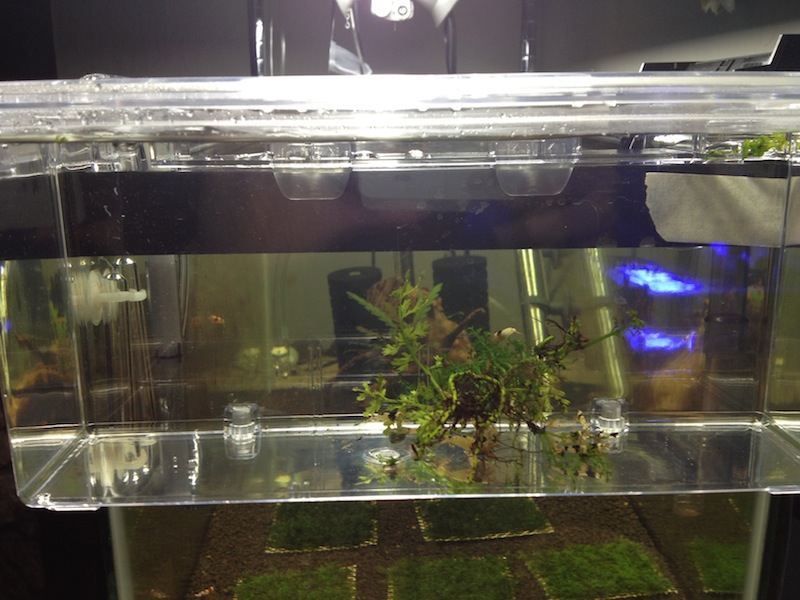
Here, I have a photo of a Marine Breeder Box I bought.  This is the largest one of three sizes (S, M, L).  
It's about 10 inches long, 6 inches high and 6 inches deep.  A good size for a temporary home for a small number of shrimp, I would say.  Currently, I am using this box to house 13 CBS of mixed sizes just fine.  

It's a clear box with good visibility inside.  In order for this box to work for you, you need two extra items that this kit does NOT include.  These two items are an air pump and air tubing.  

The reason you need an air pump for this box is because it uses bubbles to push water upwards into the box.  As the box overflows, it leaks out into the other side.  See image below.  

I have modified this box by not using any of the dividers it provides.  You can keep dividers in or remove it, it's removable for customization.  Pics below is what mine looks like in the end.


This is a pretty simple product but works wonderfully for me.  It does its job perfectly and I can see it being useful even after I house my CBS into their permanent home.  I do not recommend using these boxes as a permanent home for shrimp or fish, for that matter.  It's still too small for longterm use.  Excellent to use if you are trying to separate individuals for breeding purposes or culls though. 

Note that newborn shrimp can escape through the lining of the outflow but young shrimp of 2 weeks of age or so should be fine inside.  

Great product, I would recommend having at least one on hand.  

Saturday, January 7, 2012

Fluval Shrimp Net


I decided to purchase this net earlier at a LFS in San Francisco.  I don't necessarily "need" it but I justified it by saying all my other nets are pretty old and had a little bit of rust on em.  In any case, I picked this up for less than $10.  Normally, I used brine shrimp nets found in Petsmart.  But I figured I should try this one out.

Let's begin by going over what features this net offers.

  • Aesthetically, it looks pretty neat.
  • The net is a circle, instead of the typical rectangular shape.  It's almost like a small butterfly net.
  • The best thing about this net is that it's telescopic.  Meaning, it's extendable.  See pics below!  It's all the same net.


I can reach into my 20 gallon long tank, all the way to the very bottom without my hand getting in the water, at it's longest extension.  It's totally adjustable so you can customize how long or short you want the net to be.

I used this net for the first time today to move my Crystal Black Shrimp into a new container.  Catching the shrimp is still a pain, but that's expected.  The net's diameter is approx. 1 1/2 - 2 inches.  More than enough for dwarf shrimp.  Easier to selectively catch what you want too.  The length of the net itself is about 2 1/2 - 3 inches long, so there's room for the shrimp to go in deep enough.

My only complaint about this net is that it is NOT as soft as a brine shrimp net.  In fact, its material is more similar to a regular fish net.  If it were a brine shrimp net material, I would be much happier.  I'm not sure why they didn't implicate that when creating a net specifically for shrimp.  In any case though, it's not a terrible net.  It didn't damage my Crystal Blacks in any way.

Would I recommend this net?  Yes, but only if you don't have a net already or if you really want an adjustable handle.  If you already have a small brine shrimp net and it works perfectly fine, you can save your money and stick with it.  A net is a net.  This one has cool perks but definitely not deemed necessary and you can survive without it.

Crystal Black Shrimp

My Crystal Black Shrimp arrived on January 12, 1012.  I didn't make a post about it though, so here it is now, making an actual documentation of their arrival.  Anyway, their tank isn't really ready yet.  I don't want them to mix with the Crystal Reds, so I have them separated in their own little plastic container, connected to the CRS tank.   First they were in a plastic breeder box but I have now moved them over into a Marina Breeder Box, which I will make a review of later!

I also got 4 SSS CRS "culls" as noted by the breeder.  However, he sent me two that have a headgear!  I believe they're crowns.  One is better than the other, in terms of crown pattern.  Either way, it's a gem.  I should note that their white is not as intense as my current SS CRS.  I hope in time, it will get more solid.  If not, I'll just have to selectively breed it.

Shrimp Count:
4 SSS CRS
12 SS CBS
2 SSS CBS

Now, picture time!


Wednesday, January 4, 2012

Breeder Questions

It is always important, especially nowadays, to know where your shrimp source(s) come from.  In the Crystal Shrimp world, the source of your shrimp can determine so many factors.  For example, it is believed that Black King Kongs, Red Wines and the other new Crystal Shrimp mutations come from a Taiwanese line. There are "Pure Red Lines" that have rich coloring of thick white and solid reds coming from Japan.  It's so competitive in Japan and all of Asia that breeders in these countries have started to name their own shrimp lineage.  Names like "Ebi-ten" and "Hataka" are just two of many lines.

Creating your own line is possible, granted you selectively breed properly.  Anyone can have "Pure Red Lines" of their own.  The basics of a PRL (Pure Red Line) or PBL (Pure Black Line) is that it has no golden/snow shrimp in its genetics.  Currently, calling something "PRL/PBL" is really misleading because  PRL/PBL shrimp that are being sold at this time have thick and rich colorations with very solid white and red colorations.  Just because you have a blood line that does not have the golden/snow gene, it does not mean you'll automatically get these rich colors.  This requires a lot of selective breeding.  So, not all PRL/PBL have thick colors.  In fact, many people have PRL/PBL with really crummy colors.  They just need to selectively breed their shrimp for color to achieve such strong red/white or black/white.

Now that we have that cleared up, it is important to ask your shrimp breeder some questions before purchase.

Here are some questions I asked my breeder, when I purchased Crystal Black Shrimp from him.  Below are questions I asked and the response he gave me.  I included the answers to help me document this information for my own purposes as well.


Q. What were they kept with?  Was it a mixture of CRS and CBS or were the CBS in a tank by themselves? 
A. I have two sources to choose from for your shrimp...my 20 gal SSS CBS tank and my 75 gal High grade CBS tank. In both tanks there are a few CRS but they are not kept together.  the few are from offspring. I have been selectively breeding my shrimp intensively for 3 years now.

Q. Furthermore, were golden crystals ever introduced into the CBS population?  
A. I have NEVER introduced goldens, and both of my stock sources said they did not either, but I know one of them did introduce goldens because they throw occasional goldens in their offspring.  It usually never happens with high grades, only SSS but you never know.

Q. What grades are the shrimp that these CBS are coming from?  
A. Your shrimp are the offspring of either High grade CBS (S-SS) or SSS/SSS+

Q. How long has this colony been going on for and was "new" blood ever introduced?  If so, from where?  (country or state or continent)  If you even have the name/website origin, that would be amazing too. 
A. My colonies have been breeding successfully for ~3-3.5 years.  No new blood introduced
My colony comes from stock from Kangshiang, Chaqua, and AlphafishFarm